

 Cable Automotive / Marine




 Cable Lugs
 Cable Lug Assortment Kits
 Cable Lugs Straight Wall Closed
 Cable Glands
 Convoluted Split Tubing
 12/24v Products & Access



 Electrical Connectors


 Solar Powered Products

 LED Lights



 Tools









 Auto Parts & Categories


 Fittings







 Cleaning & Misc



 Clearance & Promotion
Latest News
How to Choose a Battery Charger for 12V and 24V
Aug
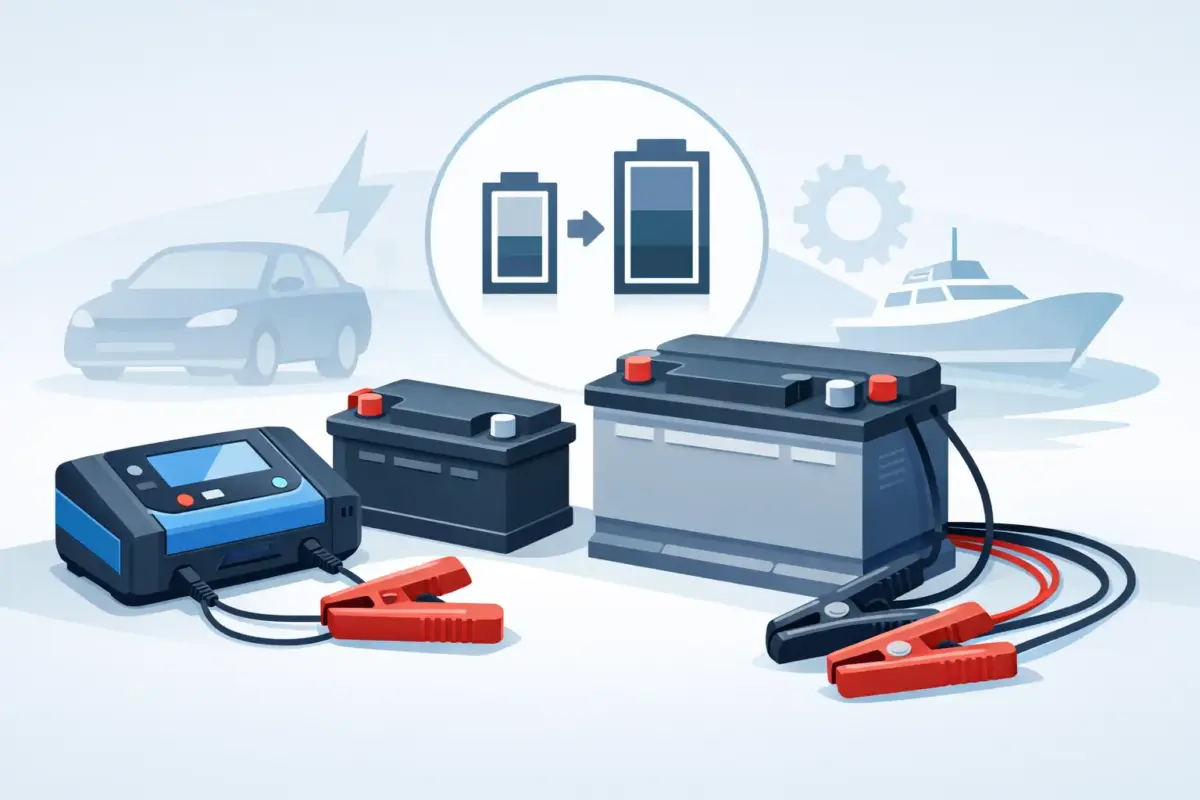
A flat auxiliary battery before a trip is inconvenient. A charger that is wrong for the battery can be far more costly. It can undercharge the battery, shorten its service life or, in the worst case, damage it. Knowing how to choose a battery charger starts with matching the charger to the actual battery bank and how the vehicle, caravan, boat or equipment is used.
For most 12V and 24V systems, the right choice comes down to five things: battery voltage, battery chemistry, capacity, charge source and installation conditions. Features matter too, but they only help once the basic match is right.
Start with battery voltage and bank configuration
The charger voltage must match the nominal voltage of the battery system. A 12V charger is for a 12V battery or 12V battery bank. A 24V charger is for a 24V battery or bank. This sounds straightforward, but series and parallel wiring can cause confusion.
Two 12V batteries wired in series create a 24V bank. That bank needs a 24V charger, connected across the full bank unless the battery manufacturer specifically permits individual charging. Two 12V batteries wired in parallel remain a 12V bank and require a 12V charger. In either case, batteries in a bank should be the same chemistry, capacity, age and condition where possible.
Do not try to charge a 24V bank with a 12V charger by clipping onto one battery at a time as a routine solution. It is slow, can leave the batteries unevenly charged and masks problems in the bank. Likewise, connecting a 24V charger to a 12V battery can cause serious battery damage.
Check the charger’s input requirements as well. A conventional workshop or garage charger typically runs from 240V AC mains power. A DC-DC charger takes power from a vehicle alternator and may also accept solar input. They serve different jobs. A mains charger restores or maintains batteries when parked, while a DC-DC charger manages charging while driving or from solar.
Match the charger to battery chemistry
Battery chemistry determines the voltage profile and charge stages the charger must use. Choosing the correct setting is not optional.
Flooded lead-acid, AGM, gel and calcium batteries are all lead-acid types, but they do not necessarily use the same absorption and float voltages. AGM batteries commonly need a higher charge voltage than standard flooded batteries. Gel batteries can be damaged by excessive charging voltage. Calcium batteries often benefit from a charger with a suitable calcium or higher-voltage mode.
Lithium iron phosphate batteries, commonly labelled LiFePO4, need a lithium-specific charging profile. A suitable lithium charger delivers the correct bulk and absorption voltage, then manages the end of the charge cycle without relying on a conventional lead-acid float strategy. A charger with a lithium setting is not automatically suitable for every lithium battery, so check the battery manufacturer’s recommended charge voltage and maximum charge current.
Avoid using an old-fashioned unregulated charger on AGM, gel or lithium batteries. These chargers can deliver voltage and current with little control. A modern multi-stage smart charger is the better fit for most automotive, caravan, marine and off-grid battery systems.
What multi-stage charging does
A quality smart charger generally moves through bulk, absorption and maintenance stages. Bulk charging replaces energy quickly. Absorption finishes the charge at a controlled voltage. Float or maintenance mode keeps an appropriate lead-acid battery ready during storage without continual overcharging.
This is particularly useful for vehicles and caravans that sit between trips. A charger with automatic maintenance mode can keep an auxiliary battery topped up, provided it has the right chemistry setting and the battery is in sound condition.
Choose charge current based on battery capacity
Charger output is measured in amps. More amps can reduce recharge time, but the biggest charger is not always the right charger.
A practical guide for many lead-acid batteries is a charger rated at around 10 to 20 per cent of the battery’s amp-hour capacity. A 100Ah AGM battery, for example, is commonly well suited to a 10A to 20A charger. A 5A charger will charge it, but slowly. A 30A charger may be suitable only if the battery manufacturer permits that current and the installation is designed for it.
Lithium batteries can often accept a higher charge current than lead-acid batteries, but their battery management system, cable sizing, terminals and manufacturer limits still set the real limit. Check the battery data sheet before selecting a high-output charger.
For a battery bank, use the total capacity. Two 100Ah 12V batteries in parallel create a 200Ah 12V bank. A charger in the 20A to 40A range may be appropriate, depending on battery specifications and how quickly the bank needs to recover. For a 24V bank, capacity is measured differently in terms of stored energy, but the charger current should still be selected against the battery manufacturer’s limits and expected duty cycle.
Remember that a charger’s rated current is not the whole story. A battery that is deeply discharged takes longer than simple amp-hour maths suggests because current tapers during the absorption stage. Cold conditions, battery age and loads left running while charging also extend the time required.
Consider where and how the charger will be used
A bench charger used occasionally in a dry workshop has different requirements from a permanently installed charger in a caravan, canopy or boat.
For portable use, look for a charger with a clear display, sturdy clamps, selectable battery modes and enough lead length to reach the battery safely. A charger with a low-current maintenance mode is useful for motorcycles, seasonal equipment and stored vehicles.
For permanent installation, mounting, ventilation and cable protection become more important. Choose a charger designed for fixed installation if it will live in a caravan or marine compartment. It should be protected from dust, vibration and moisture appropriate to the location. Marine environments demand particular attention to corrosion resistance and secure connections.
If mains power is not always available, a DC-DC charger may be the better primary charging solution. This is common in 4WD dual-battery systems, touring setups and work vehicles. A DC-DC charger compensates for voltage drop from long cable runs and modern smart alternators, which may not provide enough voltage to fully charge an auxiliary battery directly. Many models also accept a regulated solar input, reducing the need for separate charging hardware.
A solar panel does not connect straight to a battery without suitable regulation. Use an MPPT or PWM solar regulator, or a DC-DC charger with a solar input, matched to the panel, battery voltage and battery chemistry.
Look for protection features that suit real-world work
A charger should protect the battery, but it should also make installation and use less error-prone. Reverse-polarity protection, short-circuit protection, over-temperature protection and spark-resistant connections are worthwhile features, particularly on portable chargers used across different vehicles.
Temperature compensation is valuable for lead-acid batteries in areas with major temperature changes. Charging voltage should reduce in heat and increase in cold conditions. For lithium batteries, charging below 0°C can damage cells unless the battery has low-temperature charge protection or an integrated heating system. This matters for alpine travel, refrigerated work sites and equipment stored in cold sheds.
For permanently wired systems, cable size and circuit protection must match the charger output. A 25A or 40A charger needs heavier cable and correctly rated fuses than a small 5A maintenance charger. Fit fusing close to the battery where practical, route cable away from sharp edges and heat sources, and use quality lugs, connectors and cable protection. Poor connections create voltage drop and heat, limiting the performance of even a good charger.
Do not rely on repair or recondition modes
Some lead-acid chargers include repair, recovery or recondition modes. These can sometimes assist a mildly sulphated flooded or AGM battery, but they are not a cure for a failed battery. They should never be used on lithium batteries unless the battery manufacturer explicitly approves it.
If a battery repeatedly drops voltage, will not hold charge or becomes unusually hot while charging, test the battery and charging system rather than buying a larger charger. The issue may be battery age, a parasitic draw, alternator fault, corroded terminals or a load that exceeds the battery bank’s capacity.
How to choose a battery charger for the job
Before purchasing, confirm the system voltage, battery chemistry, total battery capacity and maximum permitted charge current. Then decide whether you need a 240V mains charger for workshop and storage use, a DC-DC charger for charging on the road, or a solar regulator for solar-only charging. In many touring and caravan systems, more than one charging source is appropriate.
A dependable charger is not simply the highest amp rating or the lowest-priced unit. It is the unit with the correct profile, sensible output, suitable protection and wiring that can carry the load safely. Get those fundamentals right and the battery will be ready when the lights, fridge, winch, communications gear or work equipment need it most.