

 Cable Automotive / Marine
 Cable Lugs
 Cable Lug Assortment Kits
 Cable Lugs Straight Wall Closed
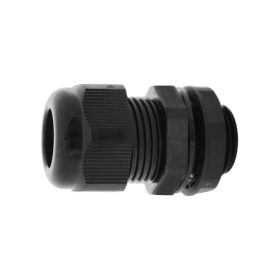 Cable Glands
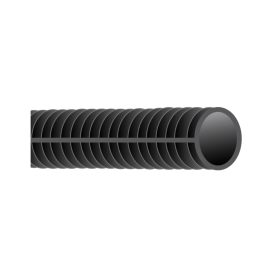 Convoluted Split Tubing
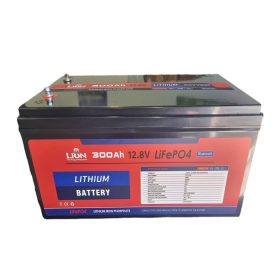 12/24v Products & Access
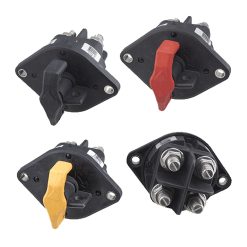
 Electrical Connectors
 Solar Powered Products
 LED Lights

 Tools
Tools


 Auto Parts & Categories

 Fittings



 Cleaning & Misc

 Clearance & Promotion
Latest News
Best Battery Isolators for 4WD Setups
Jun
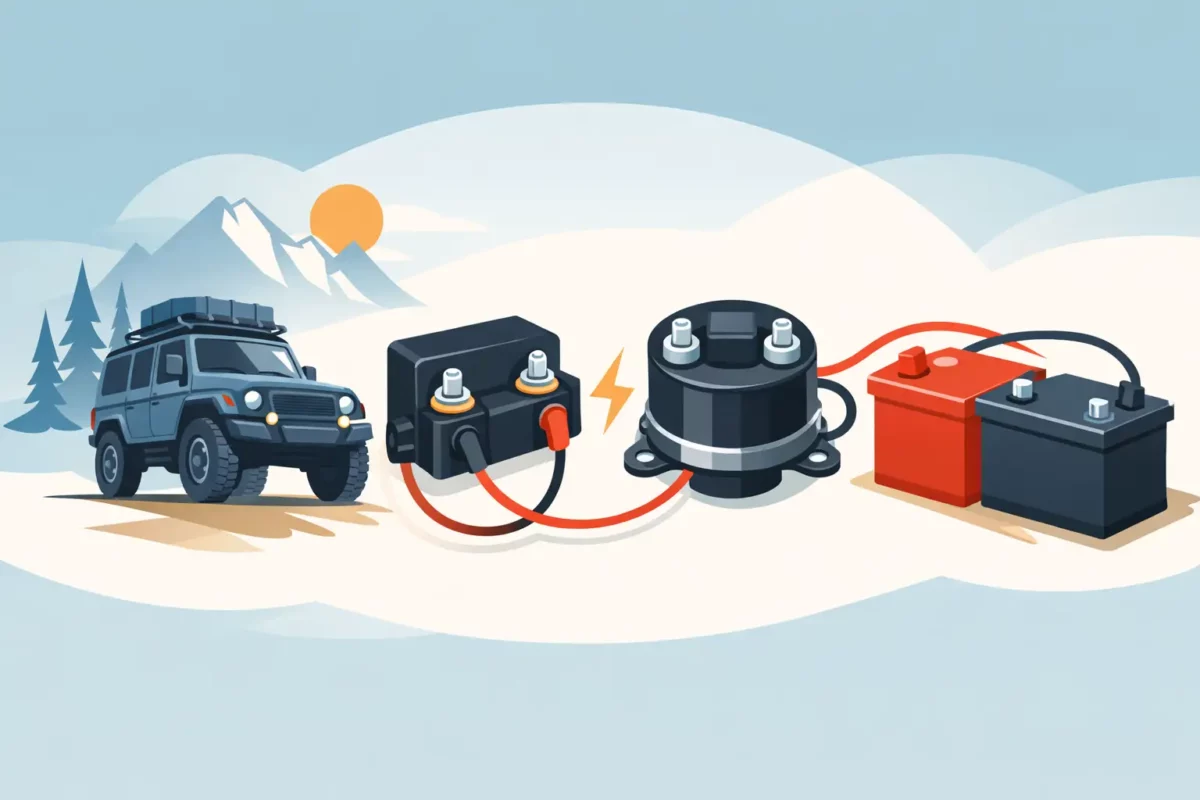
A fridge that cuts out overnight, a start battery that is flat at camp, and wiring that looked fine on paper but never charged properly on corrugations – that is usually when people start looking seriously at the best battery isolators for 4WD setups. In a touring vehicle, the isolator is not a small detail. It decides how your auxiliary battery charges, how your accessories are protected, and how reliable your power system is once you are well away from town.
What makes the best battery isolators for 4WD use?
The short answer is that the best unit depends on the vehicle, the battery chemistry, and what you are actually running. There is no single isolator that suits every dual-battery setup. A weekend 4WD with a simple AGM auxiliary battery has different needs to a late-model touring wagon running lithium, solar, a compressor fridge, lights and a trailer connection.
A good battery isolator does two jobs well. First, it separates the start and auxiliary batteries so you can run loads without risking your cranking battery. Second, it allows the auxiliary battery to charge properly when the engine is running. Where things get more technical is how it manages voltage, current and battery compatibility.
If you are choosing between products, the main categories are voltage sensitive relays, solenoid-based isolators, and DC-DC chargers with isolation functions. All can work, but they do not behave the same way.
VSR and solenoid isolators
A voltage sensitive relay, often called a VSR, is one of the most common and cost-effective options for a 4WD dual-battery setup. It monitors system voltage and connects the auxiliary battery once the start battery has reached a set voltage. When voltage drops, it disconnects to protect the cranking battery.
For many older vehicles with conventional alternators, a VSR is a sensible choice. It is simple, reliable and easy to wire if the rest of the system is sized correctly. It also suits buyers who want a straightforward solution for charging an AGM, wet cell or calcium auxiliary battery without adding too much complexity.
A manual or continuous-duty solenoid setup is similar in principle but typically gives you more control. Some installers prefer these in trade or fleet applications where serviceability matters and the charging profile is already understood. They can be very dependable, but they rely more heavily on proper design and correct switching logic.
The trade-off with both VSR and solenoid systems is that they do not boost voltage. If your alternator voltage is low, or your vehicle has a smart alternator, the auxiliary battery may never receive the charging voltage it needs. That is where plenty of 4WD owners run into trouble.
DC-DC chargers with isolator function
In many modern vehicles, a DC-DC charger is the better answer than a basic isolator. It still separates the start and auxiliary batteries, but it also regulates and boosts charge voltage to suit the auxiliary battery type. That matters if you are charging AGM, calcium or lithium batteries, especially in vehicles with variable-voltage alternators.
A proper DC-DC unit helps overcome voltage drop over long cable runs as well. In a wagon, canopy, ute tray or caravan drawbar setup, distance from the engine bay to the auxiliary battery can make a big difference. If voltage at the battery is too low, charging slows down or becomes incomplete. A DC-DC charger can compensate for that, provided the input cabling is up to the job.
This is why many people now talk about the best battery isolators for 4WD touring as if DC-DC chargers are part of the same category. In practical terms, they are. If the goal is battery separation plus dependable charging, a quality DC-DC charger often does both jobs better than a relay-based system.
Matching the isolator to your battery type
Battery chemistry should be one of the first checks, not an afterthought. AGM batteries are still common in dual-battery systems because they are durable, widely available and generally easier to integrate than lithium. They still need the right charging voltage, though. A basic VSR may work fine in one vehicle and undercharge in another.
Lithium changes the equation further. It charges differently, often draws current hard when low, and usually benefits from a charger designed specifically for lithium profiles. Fit a cheap isolator to a lithium setup and you can end up with poor charging, nuisance cut-outs or shortened battery life.
If your auxiliary battery sits in the rear of the vehicle, in a canopy or in a caravan, proper charge control becomes even more important. Long cable runs increase resistance. Add heat, dust, vibration and real touring conditions, and marginal systems stop looking good very quickly.
Current rating, voltage drop and wiring quality
An isolator is only one part of the system. You can fit a good unit and still get poor results if cable size, earthing, fuse protection and connector quality are wrong.
Current rating matters. A relay or charger should be selected for the actual charging load and the connected accessories, not just the sticker on the box. Oversizing slightly is usually smarter than running a unit at its limit, especially in Australian conditions where heat and continuous use are common.
Voltage drop is one of the biggest causes of disappointing charge performance. Thin cable, poor crimps, weak earth returns and cheap connectors all add up. If you are feeding an auxiliary battery in the back of a 4WD, use cable sized for the distance and load. Protect it properly with quality fusing close to the battery source. If the setup includes Anderson plugs, trailer connections or solar input, every join and termination needs to be up to the task.
This is also where product quality separates a dependable install from a headache. A battery isolator does not work in isolation. The cable, lugs, terminals, conduit, mounts and connectors all affect how well the system performs over time.
Smart alternators change the decision
A lot of late-model 4WDs use smart alternators that reduce output voltage to improve fuel efficiency. That is fine for the factory charging system but not always fine for an auxiliary battery. If alternator voltage drops too low, a VSR may disconnect or never provide an effective charge cycle.
That is why smart alternator compatibility should be high on the checklist. If your vehicle is newer and the charging system is variable, a DC-DC charger is often the safer and more predictable option. It costs more upfront, but it can save you from a system that never fully charges the battery you are relying on for camp power.
The same applies if you are charging a battery in a caravan or trailer from the tow vehicle. Long cable runs and voltage-sensitive systems do not always mix well. A DC-DC charger mounted near the auxiliary battery usually gives better results.
When a simple isolator is still the right choice
Not every 4WD needs a premium charger with every feature. If you have an older vehicle with a fixed-voltage alternator, a modest auxiliary battery, and only light loads such as a fridge and a few camp lights, a quality VSR can still be a very good solution.
It keeps the system simpler, installation is generally more straightforward, and fault-finding is easier if something goes wrong on the road. For trade utes, farm vehicles and practical weekend rigs, that simplicity is often worth keeping.
The key is being honest about how the vehicle is used. If the battery gets plenty of drive time, accessory loads are moderate and the cable run is short, there is no reason to overcomplicate the system. But if you are expecting fast recovery charging after repeated overnight draws, the limitations of a basic isolator become more obvious.
Features worth paying for
Some features are genuinely useful. Manual override can help with emergency linking or fault diagnosis. Adjustable battery profiles are important for different battery chemistries. Solar input on a DC-DC charger can simplify off-grid charging. Temperature compensation and ignition control can also matter, depending on the install.
What is less useful is paying for functions that do not match the vehicle or application. The best battery isolators for 4WD owners are not necessarily the ones with the longest feature list. They are the ones that suit the alternator, battery type, cable length and real accessory load.
If you are building or upgrading a system, it also pays to source the supporting hardware properly. A quality charger or isolator paired with the right cable, connectors, fuses and installation accessories will usually outperform a more expensive unit installed with undersized or low-grade components. That is where a specialist supplier such as Bluebar Industries can make the process easier, because dual-battery systems rarely come down to one part alone.
A practical way to choose
If your 4WD is older, your battery is AGM or wet cell, and the auxiliary battery is close to the engine bay, a good VSR may be all you need. If your vehicle has a smart alternator, the battery is in the rear, or you are running lithium, a DC-DC charger is usually the stronger option. If the setup includes a caravan, canopy or trailer battery, lean even harder towards managed charging.
Think about recovery time too. A system that technically charges is not always a system that charges fast enough for real touring. A fridge, lights, pumps and device charging can chew through more capacity than many people expect, particularly over a few cloudy days or short drives between camps.
The best result usually comes from matching the isolator to the whole system, not treating it as a standalone purchase. Get the charging method right, size the cabling properly, and use components built for vibration, heat and dust. That approach holds up a lot better than chasing the cheapest box on the shelf.
When your power system is built properly, you stop thinking about it. The fridge stays cold, the start battery stays protected, and the vehicle is ready to go again in the morning – which is exactly how a 4WD electrical setup should be.